Applications are invited for a contract to keep clear the channels to take water off the road in the Parish.
Please see the brief below. Closing date is 5pm Wednesday 26 August 2026.
DITTISHAM PARISH COUNCIL Incorporating the Hamlet of Capton and the Manors of Bozomzeal and Coombe
Brief for tender
Clerk: Ms Cat Radford 07979 381356
Date of Brief: 4 June 2026
Date of Parish Council consideration of responses: 2 September 2026
Contract
Parish Lengthsman Role
Location
The Parish of Dittisham
1) Term
The Contract is for an initial term commencing September 2026 to 31 March 2027 with an optional extension for two additional years with a total term of approximately three years ending 31 March 2029.
2) Key tasks
a) Monitoring and clearing as required the drainage infrastructure which drains water off the roads in the Parish.
b) Emergency clearance of drainage blockages.
c) Two full monitoring checks of drains – Autumn and pre-Spring.
d) Some preventive removal of leaves in order to prevent blocked drains, including in the Village in the Autumn.
e) Some preventive removal of removal of weeds where they affect drainage.
f) Report drains blocked by landowners to Devon County Council (DCC) on its website.
g) Jubilee Steps:
Use a salt based solution, or alternative solution agreed with DPC, four times a year to reduce slipperiness.
Clear the steps of vegetation and take it away. In the Autumn/early Winter this may require clearance up to weekly.
h) Slippery Lane
Regularly sweep to prevent the build up of algae
Devon County Council is the Authority responsible for maintenance of the Highway.
This work supplements the maintenance carried out by DCC.
Not all the drainage channels will be kept clear. The priority of the work is to keep clear the drainage necessary for road safety and passage of vehicles on the roads. The priority locations are detailed in the ‘Priority List’ provided.
3) Hours
60 hours per 12 months
Time required each month will vary depending on the season and the weather.
4) Grant funded work
DPC may be able to obtain grant funding from DCC to carry out additional pre-emptive work to improve the infrastructure which drains the water off the roads in the Parish.
Before & after photos and the time spent is required by the grant funder for this work.
5) Reporting
A monthly report should to be submitted by email to the Parish Clerk for circulation with the agenda of monthly meetings of the Parish Council.
The report will provide a summary work completed, hours, and any issues identified in the course of work.
Reports can be short. The priority is that they are clear and note anything urgent or action required.
6) Reimbursement
£25 per hour, payable on provision of a written invoice for approval by a meeting of Dittisham Parish Council
7) Tools
You will provide your own tools, safety equipment, and any other equipment required.
8) Insurance and managing risk
Proof of current, adequate insurance to carry out the work is required on an ongoing basis.
You will be responsible to draft the necessary risk assessments appropriate to delivery of the contract
9) Training
A Lengthsman is required to have Chapter 8 status in order to be able to work on the highway. If the interested contractor does not have this qualification, then the Parish Council has agreed to put that training in place for the right candidate.
10) Handover
A handover and maps will be provided.
11) Sub-Contracting
Works may be sub-contracted to a third party. Such a sub-contractor would report to the named Contractor signing this agreement. The named Contractor would be responsible for ensuring the quality and safety of the subcontractor’s work. DPC requires notification of any subcontracting in advance and evidence of applicable public liability insurance and Chapter 8 qualification must be provided in advance.
12) Health and Safety and Environmental Obligations
The Contractor shall accept full responsibility for compliance with the Health and Safety at Work Act and all other Acts and Regulations in respect of the work comprised in this Contract. The Contractor shall ensure that no harm to any person, property or the environment may arise from the Contractor’s acts or omissions in relation to the contract.
13) Submitting a quotation
If interested in the contract for services, please submit the following by email to
Name and whether applying as sole trader, limited company, partnership, etc. If appropriate, include company name, company address, company registration number.
A quotation detailing:
your experience, qualifications and how you would manage the key tasks
confirmation of your capacity to deliver the brief
confirmation of your understanding of the reporting requirements
proof of insurances held
proof of Chapter 8 certification – or willingness to obtain the qualification.
at least 2 testimonials/references
Deadline 5pm Wednesday 26 August 2026 Quotations will be considered by the Parish Council on 2 September 2026
Use the App to start photographing birds, bugs, plants, fungi: in your garden, in the lanes on the footpaths.
The App will usually identify it for you. Then it will upload to our survey where your observation will appear within a day or so. It is easy and it is quick. To see what we have so far take a look at the Dittisham Survey: Click here to see BioBlitz Dittisham (HTML) and in Cornworthy (HTML) and in Blackawton (HTML)
We will soon cover all of the parishes in the South Hams. Hopefully we will soon be able to log some swifts taking up summer residence in the church tower!
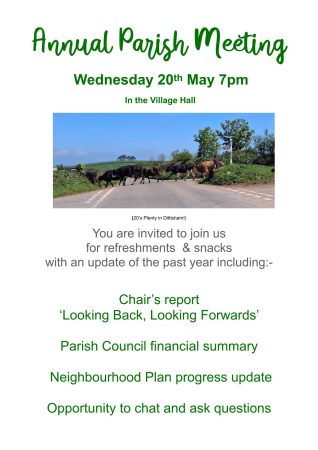
You are invited to join the Annual Parish Meeting being held from 7pm on Wednesday 20 May 2026, at Dittisham Village Hall.
There will be refreshments and snacks and an update of the past year, including:
Chairs report ‘Looking Back, Looking Forwards’
Parish Council financial summary
Neighbourhood Plan progress update
Opportunity to chat and ask questions.
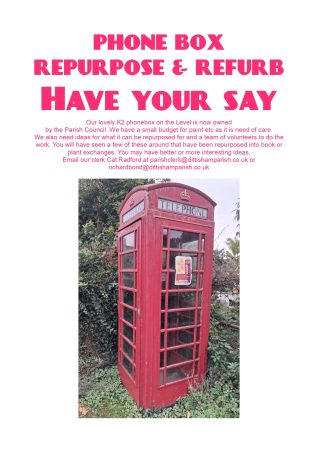
Our lovely K2 phone box on the Level is now owned by the Parish Council. We have a small budget for paint etc as it is need of care. We also need ideas for what it can be repurposed for and a team of volunteer to do the work. You will have seen a few of these around that have been repurposed into book or plant exchanges. You may have better or more interesting ideas.
What is a Neighbourhood Plan?
A Neighbourhood Plan is a community led development plan. It is a tool that helps communities proactively shape and influence their area’s future.

 Our lovely K2 phone box on the Level is now owned by the Parish Council. We have a small budget for paint etc as it is need of care. We also need ideas for what it can be repurposed for and a team of volunteer to do the work. You will have seen a few of these around that have been repurposed into book or plant exchanges. You may have better or more interesting ideas.